Solid particulate
Ambient dust drawn in by the compressor, rust and scale shed by the piping, and debris from degraded filter media. It erodes seals, clogs nozzles and contaminates product.
ISO 8573-1:2010
We measure particles, moisture and oil in your network and classify every point against the standard.
Compressed air quality is not declared, it is measured. This audit takes readings at the points that actually matter in your system and translates the results into the ISO 8573-1:2010 classification, so you know what air each process is receiving and what needs to be corrected.
Investment
USD $2,500 for 3 sampling points
+ USD $500 per additional sampling point
Prices in US dollars, before tax. Travel and special access requirements are quoted separately depending on location.
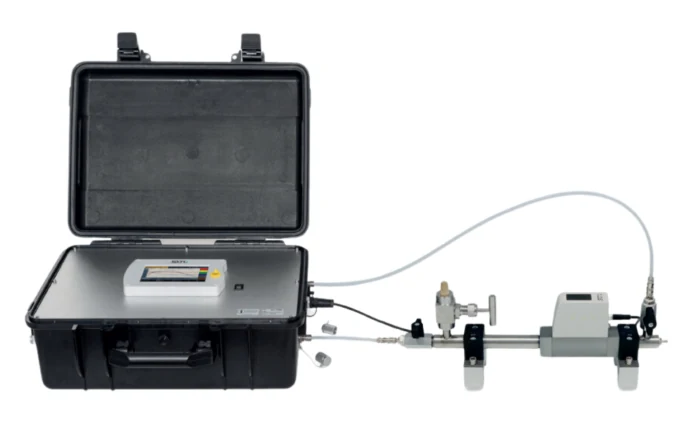
Measurement is carried out with portable equipment brought to your plant and connected to the network through an in-line sampling section. It requires neither stopping production nor dismantling pipe runs, provided a sampling connection is available at the agreed point.
A compressor does not generate clean air: it compresses ambient air along with everything it carries, and the network adds more downstream. ISO 8573-1 groups that contamination into three families.
Ambient dust drawn in by the compressor, rust and scale shed by the piping, and debris from degraded filter media. It erodes seals, clogs nozzles and contaminates product.
Atmospheric air enters saturated with vapour. Compression and cooling make it condense inside the network. It is measured as pressure dew point (PDP) and, where condensate exists, as liquid water.
The sum of aerosol, liquid oil and oil vapour. It comes from compressor lubricant and also from hydrocarbons in the intake air, so an oil-free compressor does not by itself remove this risk.
First the standard, then the revision, then the three purity classes separated by colons.
ISO 8573-1:2010 [A:B:C]
Example: an ISO 8573-1:2010 Class 1:2:1 specification requires, per cubic metre of air, no more than 20,000 particles of 0.1 to 0.5 µm, 400 of 0.5 to 1 µm and 10 of 1 to 5 µm; a pressure dew point of −40 °C or better with no liquid water; and a maximum of 0.01 mg of total oil.
Maximum values allowed per cubic metre of compressed air at the standard reference conditions. This is the scale each audited point is compared against.
| Class | 0.1 – 0.5 µm | 0.5 – 1 µm | 1 – 5 µm | Mass mg/m³ | Dew point | Liquid water g/m³ | Total oil mg/m³ |
|---|---|---|---|---|---|---|---|
| 0 | As specified by the equipment user or supplier, and more stringent than Class 1. | ||||||
| 1 | ≤ 20,000 | ≤ 400 | ≤ 10 | — | ≤ −70 °C | — | 0.01 |
| 2 | ≤ 400,000 | ≤ 6,000 | ≤ 100 | — | ≤ −40 °C | — | 0.1 |
| 3 | — | ≤ 90,000 | ≤ 1,000 | — | ≤ −20 °C | — | 1 |
| 4 | — | — | ≤ 10,000 | — | ≤ +3 °C | — | 5 |
| 5 | — | — | ≤ 100,000 | — | ≤ +7 °C | — | — |
| 6 | — | — | — | ≤ 5 | ≤ +10 °C | — | — |
| 7 | — | — | — | 5 – 10 | — | ≤ 0.5 | — |
| 8 | — | — | — | — | — | 0.5 – 5 | — |
| 9 | — | — | — | — | — | 5 – 10 | — |
| X | — | — | — | > 10 | — | > 10 | > 10 |
Particle columns: maximum number of particles per m³ in each size range. "Mass": particulate mass concentration. "Dew point": water vapour pressure dew point. "Total oil": aerosol, liquid and vapour combined. "—" means the standard defines no value for that combination.
Part 1 defines the purity classes. Parts 2 to 9 define how each contaminant is measured, and are what gives a result its technical validity.
ISO 8573-1:2010
Compressed air purity classes (contaminants allowed per m³)
ISO 8573-2:2018
Test method for oil aerosol content
ISO 8573-3:1999
Test method for humidity measurement
ISO 8573-4:2019
Test method for particle content
ISO 8573-5:2001
Test method for oil vapour and organic solvent content
ISO 8573-6:2003
Test method for gaseous contaminant content
ISO 8573-7:2003
Test method for viable microbiological contaminant content
ISO 8573-8:2004
Test for solid particle content by mass concentration
ISO 8573-9:2004
Test method for liquid water content
Base package
USD $2,500
3 sampling points
Additional point
USD $500
per extra point
Prices in US dollars, before tax. Travel, waiting time and special access or safety requirements are quoted separately depending on plant location.
Tell us how many sampling points you need and we will confirm scope, date and final price.